The CIMA-Q Data Bank and Biological Sample Bank
The CIMA-Q Data Bank and Biological Sample Bank are a structured resource bringing together sociodemographic information, results of neuropsychological, neuropsychiatric and clinical evaluations (including complete blood tests), as well as biological samples. These data come from healthy adult participants, participants with cognitive impairment (subjective or mild), or participants with Alzheimer’s dementia.
Collected over more than 10 years from the CIMA-Q cohort, this valuable data is made available to researchers interested in Alzheimer’s disease and related diseases.
Detailed CIMA-Q Project Protocol (2022-12-15)
Data dictionary (March 2026)
Demographics and diagnosis (March 2026)
Publications (June 2026)
How to access the Data Bank and the Biological Sample Bank
| 1. | Become a member of the Consortium You must be a member of the Consortium for the Early Identification of Alzheimer’s Disease – Quebec (CIMA-Q) to access the CIMA-Q Bank. Membership form to complete: Form |
| 2. | Obtain ethical approval Before submitting your access request, make sure you have ethical approval (university CER or Santé Québec) related to the project for which you are requesting access to CIMA-Q data. Important: The ethics approval number must be submitted to the Data Bank manager to access the data. |
| 3. | Complete the required documents Appendix K: Research project description form (including required additional documents). Appendices B1 and B3: Mandatory for all access requests. Appendix B2: Required only for requests for access to biological material. |
| 4. | Submit your request Submit your documents to the User Access Committee (CAU) at the following address: cimaq@criugm.qc.ca CAU Coordinator: Isabel Arsenaul, interim head of the CAU Ms. Isabel Arsenault |
| 5. | Evaluation of your request The CAU will evaluate your request within a week of receipt of the complete file. Three possible statuses: Access granted → Transmission of the file to the CIMA-Q Executive Committee for final approval. Access granted under conditions → Additional documents or information will be required. Access denied |
| 6. | Final validation Once the user agreements have been signed by the administrative manager of the CIUSSS CS MTL, the Executive Committee will issue the final approval letter. |
| 7. | Access to data and biological material Access to data (clinical, sociodemographic, biological, neuropsychological, neuroimaging) Contact the CIMA-Q Database manager to obtain your access codes: Isabel.Arsenault.ccsmtl@ssss.gouv.qc.ca Data Bank Coordinator: Isabel Arsenault: Isabel.Arsenault.ccsmtl@ssss.gouv.qc.ca Access to biological material Contact the Biobank coordinator: Isabel Arsenault: Isabel.Arsenault.ccsmtl@ssss.gouv.qc.ca |
Important note Access to biological material is reserved for CIMA-Q members from Quebec. If you are outside Quebec, ask the CAU about the possibilities of collaboration with a Quebec researcher. |
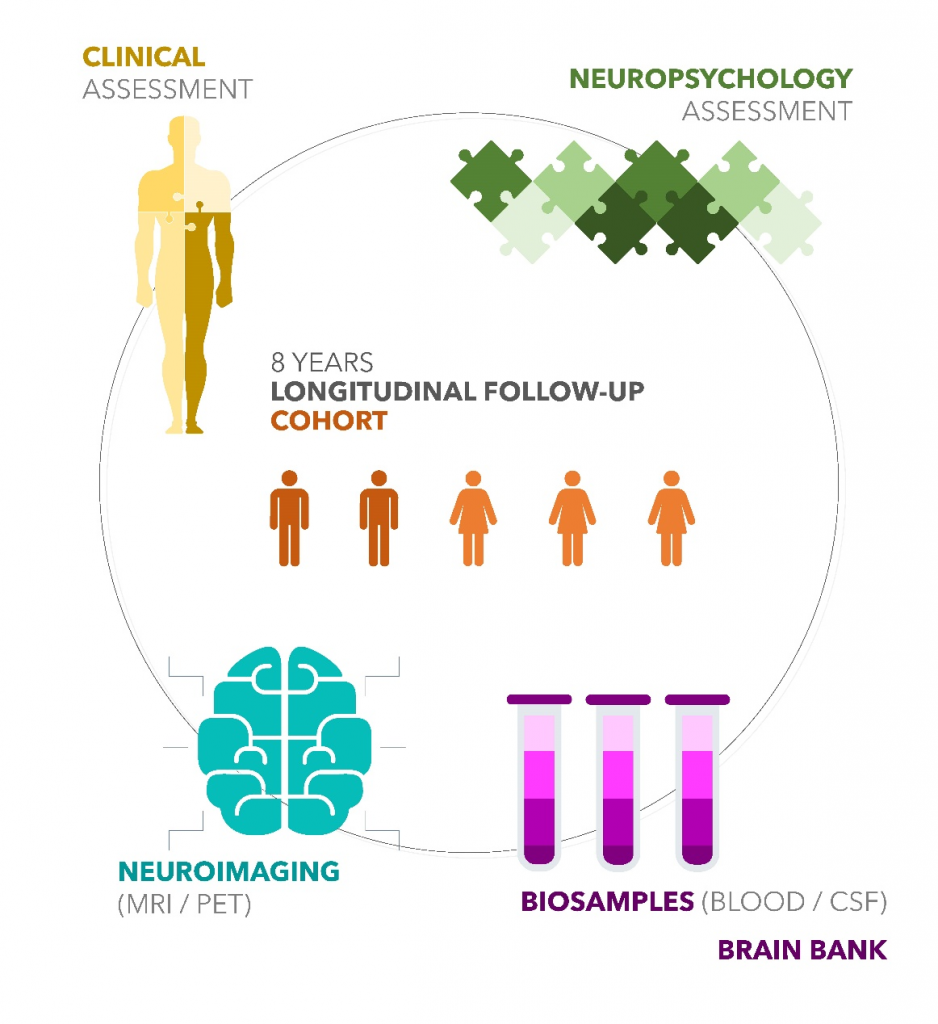
As of March 2026:
PARTICIPANTS: 423 +
M :35 % F: 65 %
Controls (C): 68
Subjective cognitive decline (SCD): 181
Mild cognitive impairment (MCI): 137
Alzheimer’s Disease (AD): 37
FULL ASSESSMENT
*Clinical assessment + neuropsychological assessment + bloodwork + blood sample collection
Initial assessments: 423
Follow-up of full assessments: 946
Participants with at least 1 follow-up assessment after baseline: N = 250
89 participants completed 1 follow-up assessment
51 participants completed 2 follow-up assessments
50 participants completed 3 follow-up assessments
41 participants completed 4 follow-up assessments
19 participants completed 5 follow-up assessments
Total full assessments completed over 11+ years N = 1023 (initial + follow-up assessments)
NEUROIMAGING
Total MRI sessions completed over 11+ years: 573
Participants with at least one MRI assessment: N = 307
132 participants completed 1 MRI
81 participants completed 2 MRIs
30 participants completed 3 MRIs
25 participants completed 4 MRIs
13 participants completed 5 MRIs
4 participants completed 6 MRIs
FDG-PET imaging
Total FDG-PET scans completed: 29
BIOSAMPLES
Blood samples: 20,000+
CSF samples (60 participants): 6,000+
CSF samples from young controls: coming soon
+ Genetic data available
BRAIN BANK
10 brains with neuropathology reports and analysis
+ Tissue samples available
All Data and Biomaterial available in the CIMA-Q bank
CLINICAL ASSESSMENT
NURSE AND MEDICAL DOCTOR ASSESSMENT
SOCIO-DEMOGRAPHIC INFORMATION
Nationality, marital status, language, social support network, income, level of education, occupation, retirement, volunteering and activities…
COGNITION
- MoCA (Montreal Cognitive Assessment)
- Telephone-Mini Mental State Examination (T-MMSE)
- Logical Memory test from the Wechsler Memory Scale (short story, immediate and delayed recall)
- Cognitive complaint question (Jessen)
- Clinical diagnosis
COGNITIVE RESERVE
- Cognitive reserve questionnaire (Bartrés score)
- Questions on bilingualism
FUNCTIONAL HABILITIES
- Alzheimer’s disease cooperative study (ADCS) – Activities of Daily Living questionnaire
- Physical self-maintenance scale (PSMS)
- Score – Clinical Dementia Rating (CDR)
NUTRITION
- Mini Nutritional Assessment® SF
GENDER IDENTITY
- Question on gender identity
PSYCHIATRIC SYMPTOMS
- Apathy Inventory (AI)
- Neuropsychiatric Inventory (NPI-Q)
- PHQ-9 (Patient Health Questionnaire)
- Mild Behavioral Impairment Checklist (MBI-C)
CHRONIC PAIN
- Chronic pain Self-Assessment
HEALTH SELF-ASSESSMENT
- Health and well-being survey (SF-36)
- Health status and auto perception of health status
SLEEP
- Chronic insomnia
- Sleep apnea (+ Stop Bang)
- REM sleep disorders
SMELL
- Olfactive capacity test (UPSIT)
VITALS SIGNS AND PHYSICAL MEASUREMENTS
- Resting state blood pressure
- Orthostatic change
- Anthropometric measures
- Grip strength
- Walking speed
MEDICAL HISTORY
- Medical history
- Family history of dementia
- Alcohol and other drug use
- History and evolution: cognitive complaint
- Surgical history
- Personal psychiatric history
- Psychiatric history of the family
- Allergies
NEUROLOGICAL EXAMINATION
- Level of consciousness
- Cranial nerves
- Nervous system
- Cerebellar functions
- Gait
EVALUATION SCALES
- Charlson Score
- Hachinski Ischemic Scale
- Fried frailty index
COMPLETE PHYSICAL EXAM
Including a blood test and a haematological profile
MEDICATION
- List of current medication
COVID-19
- History of infection and vaccination
STUDY PARTNER QUESTIONNAIRES
- Cognitive complaint question (Jessen)
- Neuropsychiatric Inventory (NPI-Q),
- Apathy Inventory (AI)
- Questionnaire relating to activities of daily living (ADCS-PI)
- Mild Behavioral Impairment Checklist (MBI-C)
NEUROPSYCHOLOGICAL, NEUROPSYCHIATRIC AND PSYCHOSOCIAL ASSESSMENT
EPISODIC MEMORY
- Rey Auditory Verbal Learning Task (RAVLT)
- Face-Name memory test (associative episodic memory)
- Cued recall from Memoria
PROSPECTIVE MEMORY
- Envelope Task
SEMANTIC PERCEPTION
- Object Decision test (BORB)
VISUAL DISCRIMINATION
- Visual Perception line orientation test (BORB)
EXECUTIVE FUNCTIONS
- Stroop-D-KEFS (4 conditions)
- Trail making test A and B
- Computerized Hayling task
- Digit Symbol test (WAIS-III)
- Alpha-span (short form)
LANGUAGE
- Verbal fluency (category – animals)
- Boston Naming Test
- Vocabulary test (WAIS-III)
PSYCHIATRIC SYMPTOMS
- Geriatric Depression Scale (GDS-30)
- Geriatric Anxiety Inventory (GAI)
- Apathy inventory (participant)
COGNITIVE COMPLAINT
- Cognitive Change Index (CCI)
- Memory auto-administered questionnaire (QAM, short form)
PSYCHOSOCIAL
- Siegrist’s Questionnaire (effort-reward imbalance at work)
- Karasek’s Questionnaire (Work related stress)
SLEEP
- Insomnia Severity Index (ISI)
- Epworth Sleepiness Scale
- Sleep quality questionnaire
DEMENTIA LITERACY
- Knowledge about Alzheimer’s disease
- Dementia Attitude Scale (DAS)
- Perception Regarding Investigational Screening for Memory in Primary Care (PRISM)
EXPERTISE
- Mobile Device Proficiency
- Technology experience profile
MRI ASSESSMENT
| ANATOMICAL: 3DT1w | |
| PATHOLOGICAL: PD and T2w | |
| VASCULAR: Flair and T2* | |
CONNECTIVITY / FUNCTIONAL:
| |
| And PET SCANS (29 scans) |
BLOOD BIOSAMPLES
- Plasma
- Serum
- Red blood cells
- PBMCs / iPSC / iPSC-derived neurons
- DNA / Buffy coat
- RNA
RESULTS:
- p-Tau 181 / p-Tau 231
- Apo E genotype
- BDNF mRNA (80 participants)
CSF BIOSAMPLES
RESULTS (60 participants):
- Aβ40 / Aβ42 / Aβ38
- Total Tau
BRAIN BANK
4 brains
PLANNED ANALYSIS :
- Thal phases of Aβ deposits
- Braak Scale of neurofibrillary degeneration and Tau
- Detailed vascular pathology
- CERAD score for neuritic plaques
- Braak Scale (α-synuclein/Lewy bodies)
- Protein Transactive Response DNA-binding protein-43 (including LATE)
- Diagnosis
Data collected during the COVID-19 pandemic lockdown
Through a collaboration, the cognitively healthy CIMA-Q participants were interviewed during the first lockdown regarding parameters suspected to be modified by the sanitary measures and the COVID-19 pandemic. The following set of questionnaires assessed COVID-19-related stress, psychiatric symptoms, subjective cognitive complaints, changes in social, cognitive, and physical stimulation, as well as adherence to social distancing recommendations.
- Socio-demographic information
- T-MMSE
- COVID-19 restrictions
- COVID-19 virus
- Social distancing recommandations
- Social network
- Changes in sleep routine
- Sleep habits
- Insomnia Severity Index (ISI)
- Physical activity
- Geriatric Anxiety Inventory (GAI)
- Problems and symptoms related to the pandemic
- Self-perception of health
- Geriatric Depression Scale (GDS-30)
- Question on memory (Jessen)
- Short QAM
- Pain Self-Assessment Questionnaire (short form)
- Alcohol and drug use
 Sylvie Belleville (Ph. D.)
 Frédéric Calon (Ph. D.)
  Simon Duchesne (eng., Ph. D.)
 Pierrette Gaudreau (Ph. D.)
 Carol Hudon (Ph. D.)
 Marie-Jeanne Kergoat (M.D.)
 Naguib Mechawar (Ph. D.)